merEKA
Since the inception of the company, we have created spaces for people to learn, experiment, develop their practice and find their way into the arts. merEKA continues that work, giving participants the opportunity to learn from experienced practitioners, build their skills, explore ideas and create work of their own.
Our programmes are open to people at different stages of their journey, whether you’re just starting out, looking to build on an existing practice or simply curious to try something new. And they’re free of charge, because we believe that access to learning and artistic development should be open to everyone.
Over the years, artists who have come through Ekamatra’s development programmes have gone on to become writers, directors, actors, producers and arts practitioners in Singapore. Some came with years of experience, while others were simply looking for a place to begin.
Wherever you’re starting from, merEKA is a space to learn, make, experiment and see where it takes you.
Artist Residencie
Artist residencies are central to Teater Ekamatra’s mission, providing artists with the time, space, and support to explore ideas, experiment, and refine their practice. Through these residencies, we nurture emerging and established artists, giving them the freedom to take creative risks, develop new ideas, and pursue work that may not otherwise have the space or resources to emerge.
Current Artists in Residence
Aida Sa’ad
Aida joined Teater Ekamatra’s Artist Residency Programme to explore design in sensory theatre. Aida first collaborated with Teater Ekamatra as the set designer for Hantu Kaki Kotor (2024), the company’s theatre production for young audiences.
As an artist-in-residence, Aida is exploring design for sensory theatre, with a focus on creating accessible and engaging experiences for persons with profound and multiple learning disabilities (PMLD).
Mysara Aljaru & Kristian-Marc James Paul
Mysara and Kristial joined Teater Ekamatra’s Artist Residency Programme to further develop Brown Is Haram.
Mysara and Kristian first developed Brown Is Haram during a residency at The Substation in 2020, later reimagining it as a lecture performance in 2021. The work explores the nuances of being brown in Singapore, touching on themes of gender, relationships, social mobility, and masculinity. It later inspired the 2022 anthology Brown Is Redacted.
As artists-in-residence, they are developing Brown Is Haram into a full-length theatrical script, expanding its narratives and exploring its possibilities as a work of theatre.
Juan-Camilo Riaño-Rodriguez
Juan Camilo’s residency explores the development of a decolonial and transformative approach to theatre-making with Teater Ekamatra.
Through a series of practice-based workshops with Ekamatra’s artists and team, the residency will examine the company’s artistic practices through embodied, creative, and dialogical methods. The process will explore ideas of relationality, memory, re-existence, radical imagination, resistance, and solidarity, while creating space to reflect on and articulate the practices that shape Ekamatra’s work.
The residency will culminate in the development of a pedagogical module that Teater Ekamatra can adapt and integrate into its ongoing development programmes for artists and community practitioners, alongside a collective archive of reflections and insights gathered throughout the process.
Ruby Jayaseelan
Ruby’s residency focuses on the development of vadivam (Tamil: shape), an embodied experimental work that brings together dance, physical theatre, performance art, and movement practice.
The work explores cycles of death, compost, rebirth, and re-death, using the body to examine histories and layers of colonisation, gender, power, identity, and inherited cultural structures. It considers how these forces shape the ways we move, perform, and understand ourselves and our communities.
Through collaborative research with traditional dance and arts practitioners, Ruby is exploring ways of working with embodied knowledge beyond fixed ideas of tradition and aesthetics, and how these practices can open up new ways of thinking, moving, and relating.
Past Artists in Residence
Ali Mazrin
Ali first joined Ekamatra in 2018 and has since collaborated with the company both on and off stage. His script, Jamil Sekadar Nama, was originally submitted to New Scripts Garage: Malay-language edition, an initiative jointly run by Centre 42 and Teater Ekamatra.
As an artist-in-residence with Teater Ekamatra, Ali worked with a dramaturg and received resources and support to develop Jamil Sekadar Nama into a full-length play. He concluded the residency with a closed-door dramatised reading of the work, bringing together the material developed during the residency and offering an opportunity to experience the script in performance. The reading also created space for invited artists and practitioners to respond to the work and share feedback as Ali continues to develop the script.
Irsyad Dawood
Irsyad residency focused on exploring expanded theatre, headphone-verbatim theatre, and new approaches to theatre-making. Throughout the residency, he developed a headphone-verbatim work centred on the life of Cik Ismail, a 70-year-old Malay Muslim barber and musician, exploring the tensions between identity, faith, and art.
The residency culminated in the development of a new headphone-verbatim play that incorporates live dramaturgy, with a participant receiving a haircut from the performer while engaging in conversation about their own life and reflections in response to Cik Ismail’s story. The process also included collaborative playdates with other artists, exploring verbatim theatre, audience interaction, and alternative approaches to performance-making.
Nabilah Said
Angkat 2016 - 2017
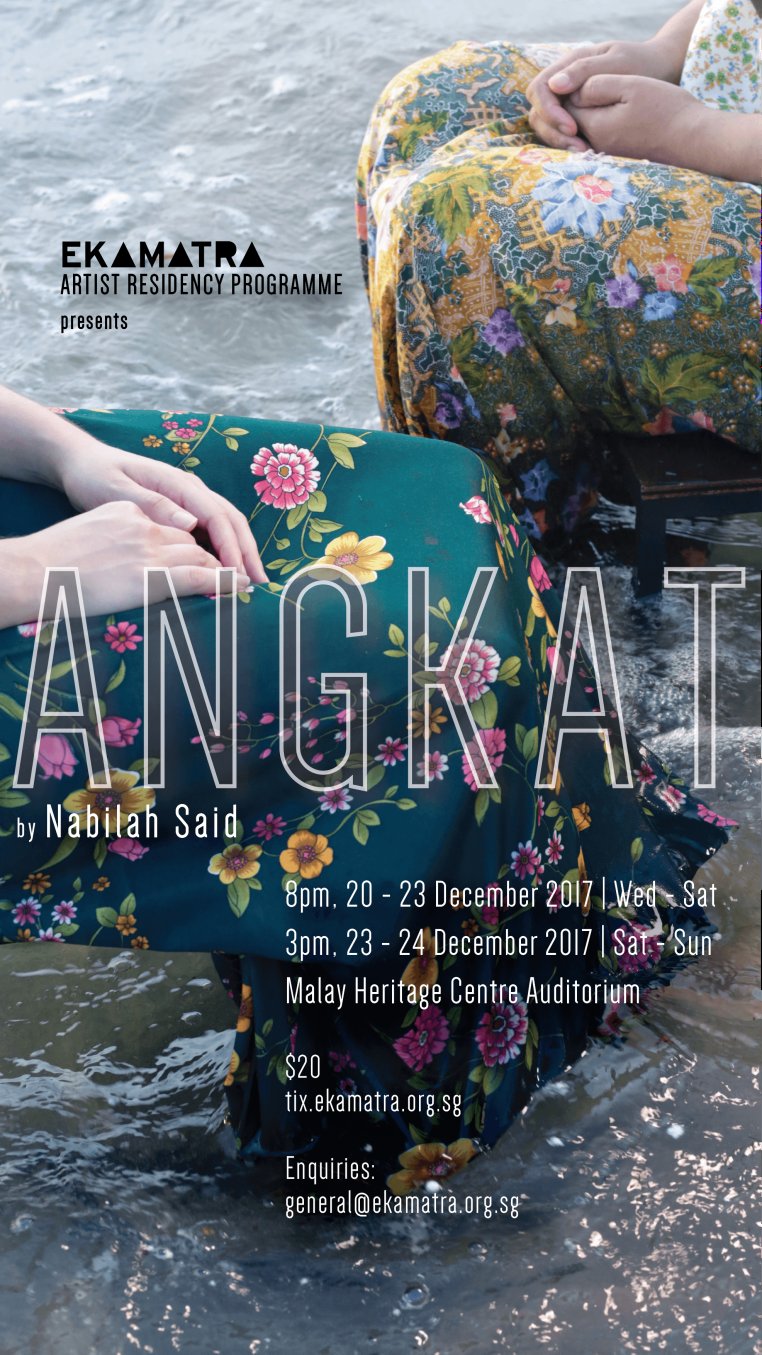
Angkat follows Salma, a National Idol hopeful, who is asked to alter her image so as to appeal to the masses. As compromises are made, she starts to question her identity, creating a clash between her roots and her upbringing as an adopted child.
Salma and her adoptive Khadijah are made to face the consequences of their actions in the past, present and inevitable future. Will the forces of fate and nature tear them apart or bring them closer together?
Safuan Johari
Packing/Unpacking by Safuan Johari
3-6 February 2022, Greymatter, Aliwal Arts Centre
_1743270279.jpg)
Packing/Unpacking is a multimedia installation that explores the visual choreography of a cubic constellation that sways and swivels to the tones and melodies of a generative music composition. From gridded formations to swarming undulations, these movements undergo shifting cycles to create its own living and ever evolving universe.
Taking inspiration from the multitude of moving boxes surrounding the artist as he sat in the space taking a deep dive into the company’s archival material, Safuan puts the two and two together; to create a universe of boxes that alludes to Teater Ekamatra’s decades of colourful adventures navigating through the issues of multiethnic reality of Singapore. These issues are often controversial and profound but the company has never failed to confront and pack them into technicolour productions on stage. Putting things in and out of boxes can be a difficult process, Packing/Unpacking is an ode to Teater Ekamatra for always doing it with colourful vibrance and a chuckle or two.
As a generative audio-visual piece, Packing/Unpacking is not a recorded content playback. The piece is continuous and constantly generates new alternations of sights and sounds. The meandering sonic modulations and visual ornamentations seem familiar from cycle to cycle, they are however, never the same.
Rizman Putra
Chonteng: The Cult of Creatures by Rizman Putra
23-28 April 2019, Greymatter, Aliwal Arts Centre
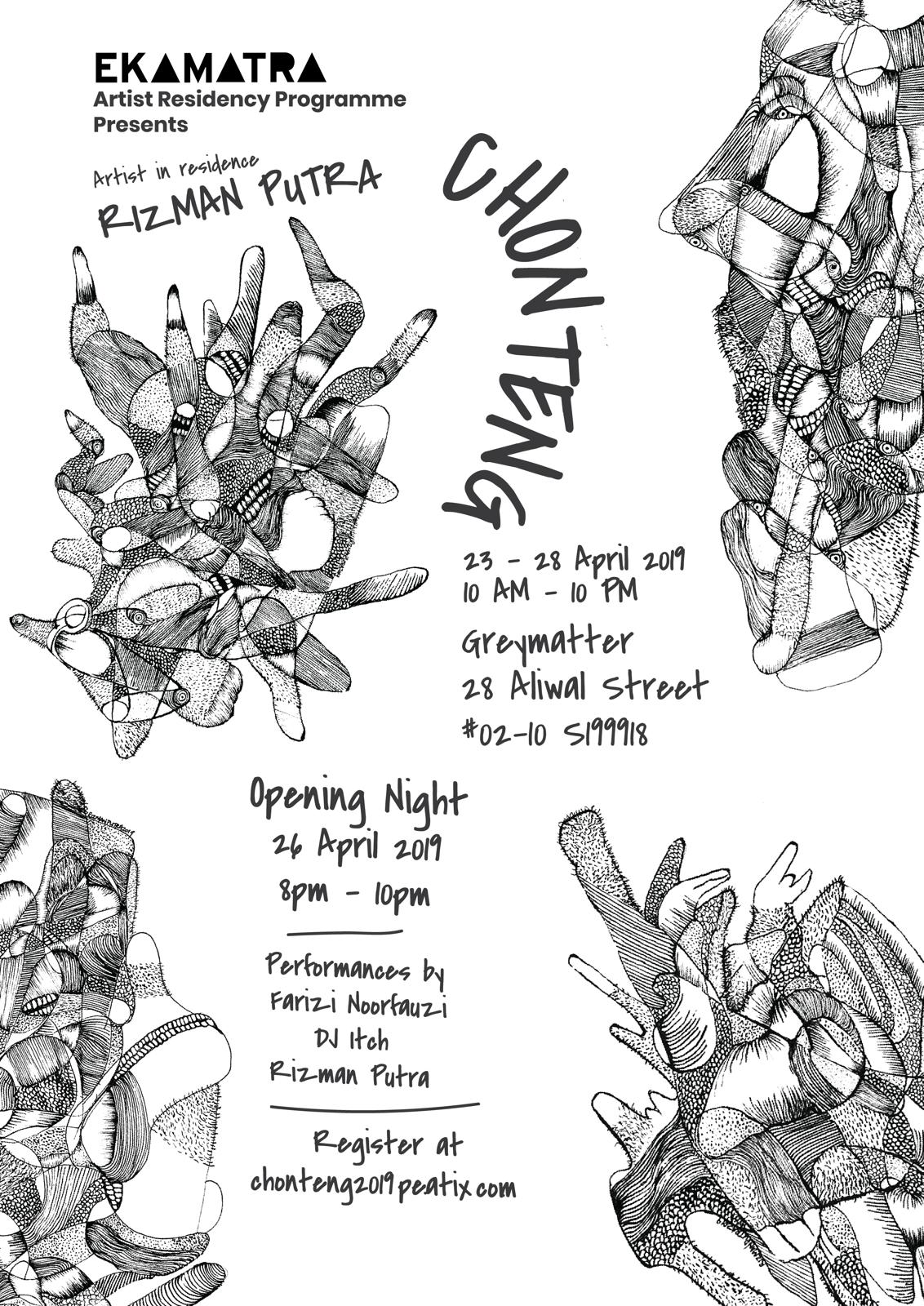
Chonteng, which translates to “doodle” in English, is a drawing installation that explores line and mark-making, loosely based on the method of automatic drawing. The work documents a stream of iconography and creatures drawn from the artist’s consciousness.
Zul Mahmod
No Substance
28 to 30 August 2014
Laboratory glassware mounted on copper pipes will take pride of place at renowned sound artist Zul Mahmod’s upcoming exhibition NO SUBSTANCE. The installation, held in Teater Ekamatra’s Greymatter Studio at Aliwal Arts Centre, is a continuation of Zul’s first-phase exhibition at Yeo Workshop in Gillman Barracks earlier this year.
From just five pieces in Phase One, Zul has expanded his exhibition to a 25-piece orchestra capable of playing 127 different notes. So far, he has written eight compositions for the musical sculpture, which will be performed while the works are on display.
The inspiration for NO SUBSTANCE, Zul says, came from the urban landscape of “developing cities,” which he describes as resembling “infrastructure without a soul.” He envisions NO SUBSTANCE as a meditation on the place of the human element in the big city. “The infrastructure, who is it for, really?” he asks. “Is it for us or for the economy? I mean, you need both, but there has to be a balance.”
The materials Zul employs in NO SUBSTANCE point to his preoccupation with the theme of “a manufactured city” devoid of people or soul. “In terms of the sound pieces, it’s empty, it’s just glass,” he says. “There’s no tone or melody to this piece.” Similarly, he eschewed the mass-produced wooden stools he used as display-stands in the earlier iteration of NO SUBSTANCE, favouring instead stands that he made himself with copper pipes of various dimensions. Although this required more time and effort, he finds himself satisfied by the liberty of transcending the limitations of mass-produced supplies.
As an innovative sound artist known for his bold design choices, Zul is ambitious about future possibilities for the next incarnation of NO SUBSTANCE, such as having the sound-pieces triggered by a dancer’s movements or controlled remotely by an iPad. “Usually, when it comes to theatre, you have the script, directions, then you come up with the set and the sound,” Zul explains. His method, on the other hand, reverses this process and calls attention to the technical nature of theatre practice.